


Our Favourite Ways to Enjoy Keeper
Discover our favourite ways to incorporate Keeper into your everyday wellness routine, from nourishing breakfast bowls and...


Ice Baths vs Saunas: Which Wins for Longevity?
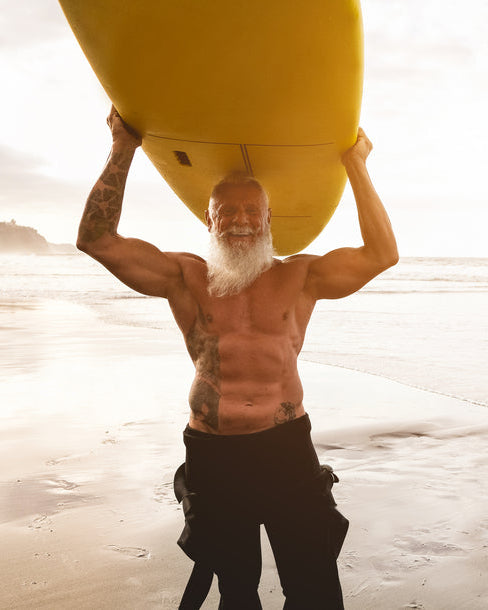
Your social media feed is probably full of ice bath warriors and sauna evangelists, each claiming their method is the ultimate longevity hack. Wim Hof disciples swear by cold exposure, while Finnish sauna enthusiasts point to decades of research on heat therapy. So which extreme actually delivers better results for healthy aging? The answer might surprise you.
NMN vs NAD+: The Science Behind the Hype
Let's get straight to the point about NMN and NAD+ supplements – what they actually do, why your body can't absorb NAD+ directly, and how to choose the right longevity supplement for your needs.

PQQ vs CoQ10: The Mitochondrial Power Duo
You've probably heard of CoQ10 – it's been the darling of the supplement world for decades. But there's a newcomer that's got longevity researchers excited: PQQ. While most people debate which one is "better," the real question is why you'd choose between them when they work together like a perfectly orchestrated team.


When we first started talking about Keeper, none of us were actually looking to start a supplement company.
My brother Angus and I were working together in our family property business, Sabrina had her own career, and between the three of us, health and wellness had simply become a big part of our lives. We read the research, listened to the podcasts, spoke to practitioners and, inevitably, accumulated more and more supplements.
In my case, my kitchen bench had started to look like a pharmacy.
The irony wasn't lost on us. We were putting so much effort into trying to look after our health that the routine itself had become unnecessarily complicated. That frustration became the starting point for Keeper.
What began as conversations around family dinners eventually turned into a much bigger question: could we take the complexity of modern wellness and make it genuinely simpler, without compromising on what was inside?
Several years later, Keeper Health launched.

None of us came from the supplement industry, and in hindsight I think that helped shape Keeper more than we realised at the time.
We didn't start by asking what would be easiest to manufacture or what we could quickly bring to market. We started as consumers asking questions.
Why did maintaining a supplement routine require so many bottles? Why were products often either highly clinical or overtly "wellness" in their presentation? Why was it so difficult to understand exactly what you were getting for your money? And why wasn't independent testing something consumers could simply expect?
Most importantly, we kept coming back to the same question: what would we genuinely want to take ourselves?
That sounds simple, but it became a useful filter for almost every decision that followed. It also meant Keeper took considerably longer to build than any of us initially imagined.
We spent years developing the four formulations we eventually launched with: Complete Longevity, Body Boost, Good Gut and Daily Reset. There were endless iterations of formulations, ingredient sourcing, flavours, packaging and design.
And then there was everything we hadn't anticipated.

One of the great misconceptions about launching a brand is that most of the work is creating the product. In reality, the product is only the beginning.
Very quickly, the three of us found ourselves learning about manufacturing, international freight, regulatory frameworks, trademarks, warehousing, fulfilment, packaging, testing, website development, photography, customer service and digital marketing.
I remember spending months planning for our products to be warehoused in Hong Kong before realising that the economics simply didn't work. Only a few months before launch, we changed our entire logistics model and moved everything to New Zealand. At the time, it felt enormous. Now it's simply one of hundreds of decisions that got us here.
There were also the financial realities of manufacturing a physical product. Minimum order quantities mean you can't necessarily make a few hundred units, put them online and see whether people like them. Long before your first customer places an order, you're committing significant capital to ingredients, packaging and inventory.
For a family-funded business like ours, those decisions feel very real. We chose to fund Keeper ourselves because we wanted to retain control over the things that mattered most to us, particularly formulation and quality. It has meant scrutinising every investment, but it has also given us the freedom to think long term.
We've always said we'd rather compromise on our own margins than compromise on the product.
When Man of Many recently explored the business behind Keeper, I appreciated that they focused on much of this less visible side of building a supplement company — the manufacturing, logistics, capital, testing and commercial decisions sitting behind the finished product.
Man of Many feature: Keeper Health Is Here to Challenge Australia's $6.3 Billion Supplement Industry

More recently, Time And Tide described something about Keeper that resonated with me from a completely different perspective.
Their article explored the paradox of modern wellness: we have access to more information about our health than ever before, but managing that information can itself become another job.
Sleep scores. Steps. Blood tests. Wearables. Supplements. Biomarkers. Protocols.
There is always something else we could be measuring, taking or optimising. Time+Tide described Keeper's approach as taking responsibility for that complexity so the consumer has less to manage.
I think that's probably one of the best descriptions I've read of what we've been trying to build. Because simplifying something doesn't necessarily mean making what sits behind it simple. Quite the opposite.
Complete Longevity, for example, contains 18 active ingredients in one daily scoop. For the person taking it, the experience is intentionally uncomplicated. Behind that scoop are individual ingredient specifications, sourcing requirements, manufacturing considerations, testing protocols and countless decisions about what should, and shouldn't, make it into the formula.
The work happens behind the scenes so that the customer's routine can feel easier.
Time+Tide feature: More Data, Less Life: The Paradox of Keeper's Modern Wellness

The other thing we understood relatively early was that supplements are an unusually difficult category in which to earn trust. A beautiful brand isn't enough.
Consumers are putting these products into their bodies every day, and I think they are right to ask questions about what's actually inside them.
As consumers ourselves, we wouldn't have felt comfortable taking a supplement that hadn't been independently tested. It therefore didn't feel right to ask our customers to do something we wouldn't do ourselves.
That's why we made the decision to independently test every production batch. It adds cost, time and complexity to manufacturing, but for us it has never felt like an optional extra.
We've tried to apply the same philosophy to transparency around our formulations. We publish the ingredients and doses because we don't think customers should have to guess how much of something they're actually taking.
Pricing was approached in much the same way. We wanted Keeper to feel premium because of what went into the products, not simply because of what we charged for them. We spent an enormous amount of time comparing Complete Longevity against equivalent ingredients and other premium all-in-one products, not because we needed to justify a price we'd already chosen, but because we wanted customers to be able to make that comparison for themselves.
The more time I've spent working in this category, the more convinced I've become that trust isn't something a brand can tell people it deserves. You have to keep earning it.
One of the assumptions we probably got wrong at the beginning was believing that if we built something genuinely good, people would naturally find it. The wellness category is incredibly noisy.
There are established brands, new brands, new ingredients, new trends and new promises appearing constantly. Creating the product is only half the challenge. The other half is helping the right people discover it and understand why it exists.
That's where much of my focus now sits across Keeper's commercial strategy, communications and partnerships. For me, the goal isn't simply getting Keeper in front of as many people as possible. It's finding the right environments, people and partners to introduce the brand in a way that feels credible and useful.
Our recent partnership with GoodnessMe has been a great example of that. Getting Keeper products directly into people's hands gives someone an opportunity to experience the brand rather than simply see another advertisement for a supplement online.
Likewise, seeing publications such as Man of Many and Time+Tide independently explore Keeper from very different perspectives has been an exciting milestone for us.
Not simply because our name appeared somewhere, but because both pieces opened up conversations about ideas that are fundamental to why we built Keeper in the first place.

When you're building a new business, there is a constant temptation to ask: what else can we do? Another product. Another market. Another opportunity.
At the moment, we're deliberately trying to resist some of that.
We spent years developing the four products we have. Our biggest opportunity right now isn't necessarily creating more, it's introducing more people to what we've already built.
There are certainly bigger ambitions for Keeper. International expansion is something we're actively exploring, and eventually there will be new products. But growth only makes sense to us if we can maintain the standard we set at the beginning.
Any future Keeper product will have to earn its place. It needs to solve a real problem and make someone's wellness routine genuinely simpler. We're still a very young business, and I'm sure there are plenty of lessons ahead of us.
But perhaps the biggest thing I've learned so far is that building a brand isn't really one big decision. It's hundreds of small ones.
What you put in. What you leave out. Where you spend. Where you don't. The partners you say yes to. The opportunities you say no to. The standards you're prepared to maintain when nobody outside the business would ever know the difference.
Individually, those decisions can seem insignificant. Collectively, they become the brand. And that's what we're building with Keeper.


