


What Does a Longevity Stack Really Cost?
What does a longevity stack really cost? We compared Complete Longevity with purchasing its 18 active ingredients individu...


Ice Baths vs Saunas: Which Wins for Longevity?
Your social media feed is probably full of ice bath warriors and sauna evangelists, each claiming their method is the ultimate longevity hack. Wim Hof disciples swear by cold exposure, while Finnish sauna enthusiasts point to decades of research on heat therapy. So which extreme actually delivers better results for healthy aging? The answer might surprise you.

NMN vs NAD+: The Science Behind the Hype
Let's get straight to the point about NMN and NAD+ supplements – what they actually do, why your body can't absorb NAD+ directly, and how to choose the right longevity supplement for your needs.

PQQ vs CoQ10: The Mitochondrial Power Duo
You've probably heard of CoQ10 – it's been the darling of the supplement world for decades. But there's a newcomer that's got longevity researchers excited: PQQ. While most people debate which one is "better," the real question is why you'd choose between them when they work together like a perfectly orchestrated team.

Most of us do not simply want more years. We want more good years. We want to stay energetic, active and mentally sharp. We want to keep doing the things we enjoy and continue looking and feeling like ourselves as we get older.
That is the idea behind healthspan. It is not something to start thinking about once you already feel old. The choices you make earlier in life can support how you feel now and help you build a strong foundation for the years ahead.
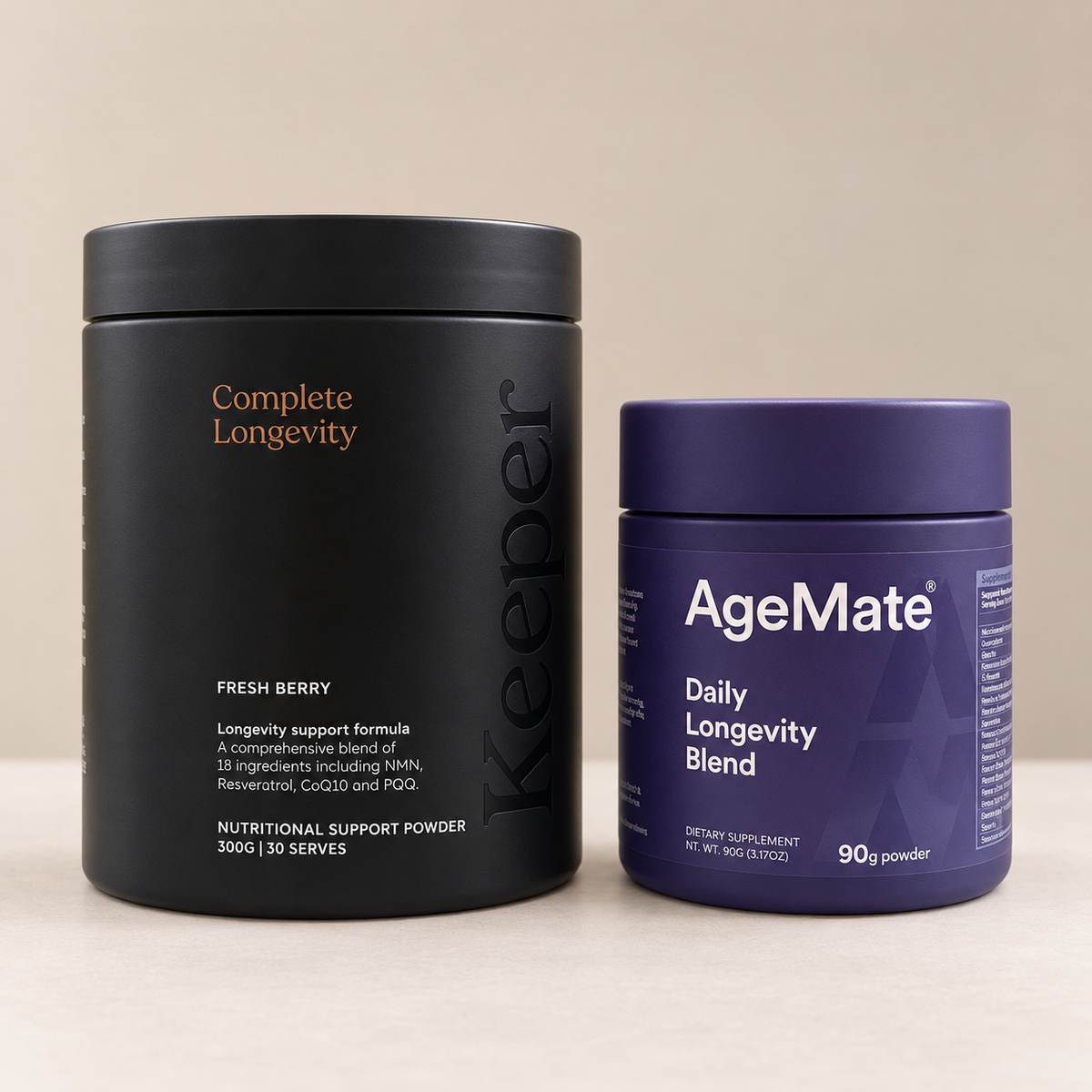
This growing interest in healthspan has brought supplements such as AgeMate Daily Longevity Blend and Keeper Complete Longevity into the conversation.
As we get older, our natural NAD+ levels tend to decline. That matters because NAD+ helps our cells produce energy and carry out important repair processes. NMN gives the body something it can use to make NAD+.
AgeMate and Keeper Complete Longevity both provide 500 mg of NMN per serve. But NMN is only the beginning.

Both drinks start with 500 mg of NMN. Keeper then adds 150 mg of NR, another ingredient the body can use to make NAD+. It also includes 100 mg of apigenin, a plant compound being studied for its relationship with NAD+ metabolism.
Keeper includes 500 mg of TMG as well. When the body uses NAD+, it needs to process some of what is left behind. TMG helps with that process, which is why it sits alongside NMN and NR in Keeper’s formula.
AgeMate provides 50 mg of DMG, plus folate and vitamin B12. Those nutrients have useful roles, but DMG does not do the same job as TMG in this process. Keeper has made a more deliberate choice around its NAD+ ingredients.

If you have used AgeMate before, take another look at its current label. AgeMate says it removed spermidine, pterostilbene, hyaluronic acid and vitamin B6. It added zinc and biotin, and increased its glycine and L theanine.
If spermidine was one of the reasons you chose AgeMate before, this change is worth knowing about. Keeper still includes 10 mg per serve.
Keeper Complete Longevity and AgeMate Daily Longevity Blend both offer a simple one scoop daily routine. Each provides 500 mg of NMN per serve and costs $99 for 30 serves at the standard one time purchase price.
The real difference is what each formula provides beyond NMN. Keeper combines 18 active ingredients and approximately 6 g of declared active ingredients per serve, with a stronger focus on NAD+ support, cellular energy, cellular maintenance and antioxidant protection. AgeMate provides 15 active ingredients and approximately 2.8 g per serve, with more of its formula devoted to familiar vitamins, minerals and L theanine.
Here is how the two formulas compare.

Amounts are per serve from each brand’s published label. The total adds up the declared active amounts, not the weight of the whole scoop. A greater total does not by itself show that a drink works better; the choice of ingredients matters. Subscription prices can differ from the standard one time price.
Try five days of Keeper Complete Longevity for $10 with free shipping
Keeping up with a busy day takes more than one ingredient. AgeMate includes magnesium and vitamin B1, which help the body use energy from food. Keeper adds ingredients that AgeMate’s current formula does not contain.
Its 2 g of taurine has been studied in relation to physical performance. The 100 mg of ubiquinol CoQ10 plays a part in making energy inside cells. PQQ, at 20 mg, has been studied for aspects of memory and attention. Keeper also includes 500 mg of calcium AKG, a compound connected with the body’s energy cycle. Together, these choices give Keeper a broader approach to staying active and mentally engaged.
Your body is always renewing itself. Autophagy is one of the ways it breaks down and reuses worn cellular parts. Keeper includes 10 mg of spermidine, which is being studied for its connection with that process. It also contains 75 mg of fisetin and 50 mg of trans resveratrol, plant compounds being investigated for how cells respond to stress as we age.
AgeMate offers vitamins and minerals that support normal cell function. It used to include spermidine, but its current formula does not. It also does not list fisetin or trans resveratrol. For someone choosing a drink specifically for its longevity ingredients, that is a meaningful difference.
Both products include glycine: 1 g in Keeper and 1.1 g in AgeMate. AgeMate also includes vitamin C and MSM. Keeper takes a different approach by pairing its glycine with 500 mg of NAC. The body uses glycine and a component supplied by NAC to make glutathione, one of its own protective compounds.
AgeMate has slightly more glycine and offers vitamin C. Keeper supplies both ingredients in the NAC and glycine pairing, which is the more targeted choice for supporting the body’s own glutathione production.
AgeMate includes vitamin B1, vitamin C, folate, B12, zinc and biotin that Keeper does not list. It also shares magnesium, choline, vitamin D3 and one form of vitamin K2 with Keeper. Its amount of K2 as MK7 is higher.
Keeper includes magnesium as magnesium glycinate, choline and vitamin D3, and provides K2 in both MK4 and MK7 forms. AgeMate uses magnesium citrate. Both are recognised forms, and their label amounts should not be compared as though they necessarily state the same amount of elemental magnesium. Keeper’s distinction is the way these foundational nutrients sit alongside its broader range of longevity ingredients.
AgeMate includes 200 mg of L theanine. This ingredient has been studied for helping people feel calmer while staying focused, which may appeal to someone looking for support on demanding days. Keeper does not include L theanine. AgeMate also includes several vitamins that Keeper does not list.
These are real reasons someone might choose AgeMate. If your main goal is a formula built around ingredients selected for longevity, Keeper puts more of its serve into that goal.
Keeper independently tests every batch through a third party for the strength of key active ingredients and screens for heavy metals, microbes and mycotoxins. These checks help verify what goes into the drink. AgeMate also describes independent product testing, so testing alone is not a reason to assume one brand is better than the other.
Both drinks fit the same simple routine: one scoop each day. That convenience can make it easier to keep up the habit. The meaningful choice is what you get in the scoop.
If calm focus and a wider selection of everyday vitamins are your priorities, AgeMate has a case. Its 200 mg of L theanine is a clear difference, and it provides the same 500 mg of NMN as Keeper.
If you are choosing a drink specifically for staying active and feeling capable for longer, Keeper offers more of the ingredients selected with longevity in mind. It combines the same NMN amount with NR, TMG, taurine, ubiquinol, PQQ, spermidine and the NAC and glycine pairing in one daily formula. For anyone considering buying these longevity ingredients separately, we have also compared the potential cost and complexity of building a similar routine yourself. Both Keeper and AgeMate cost $3.30 per serve at their standard one time price.
Same standard price. Same NMN. More longevity ingredients in Keeper.

Try Keeper Complete Longevity for 5 Days | $10 with Free Shipping
Ingredient research does not establish that either finished drink extends healthspan. Comparison based on the ingredient panels, product information and standard one time purchase prices published by Keeper and AgeMate, checked on 21 September 2026. Prices and formulas may change.


